- AI in Jobs in Healthcare
- AI in Jobs in Education
- AI in Jobs in Business and Offices
- AI in Jobs in Manufacturing
- Creates New Job Opportunities
- Improves Work Quality
- Saves Time and Energy
- Makes Work Safer
- Job Loss Fear
- Skill Gap Problem
- Income Inequality
- Over-Dependence on Machines
- What Is Reskilling?
- What Is Upskilling?
Artificial Intelligence, also known as AI, is no longer a future idea. It is already part of our daily lives. From mobile phones and social media to online shopping and customer support, AI is everywhere. One of the biggest areas where AI is creating change is jobs. Many people feel excited about AI, while others feel scared that machines may take away their work.
So what is the real impact of AI in jobs? Is AI a danger, or is it an opportunity? The truth is, AI is changing jobs, not just removing them. Some jobs are disappearing, some are changing, and many new jobs are being created.
In this article, we will explain the impact of AI in jobs, the problems it creates, and the solutions to deal with those problems all in very simple and clear language.
What Is Artificial Intelligence in Simple Words?
Artificial Intelligence means machines that can think, learn, and make decisions like humans. AI systems can understand data, recognize patterns, and improve over time.
For example:
- Voice assistants like Siri or Google Assistant
- Chatbots that reply to customer questions
- Recommendation systems on YouTube or Netflix
- Self-driving cars
These systems do not have feelings, but they can do many tasks faster and more accurately than humans.
Understanding AI in Jobs Today
AI in jobs means using artificial intelligence to do work that humans used to do. This can include simple tasks like data entry or complex tasks like analyzing medical reports.
Today, AI is being used in:
- Offices
- Factories
- Hospitals
- Schools
- Online businesses
AI helps companies save time, reduce mistakes, and increase productivity. But at the same time, it raises questions about job safety.
How AI in Jobs Is Changing the Workplace
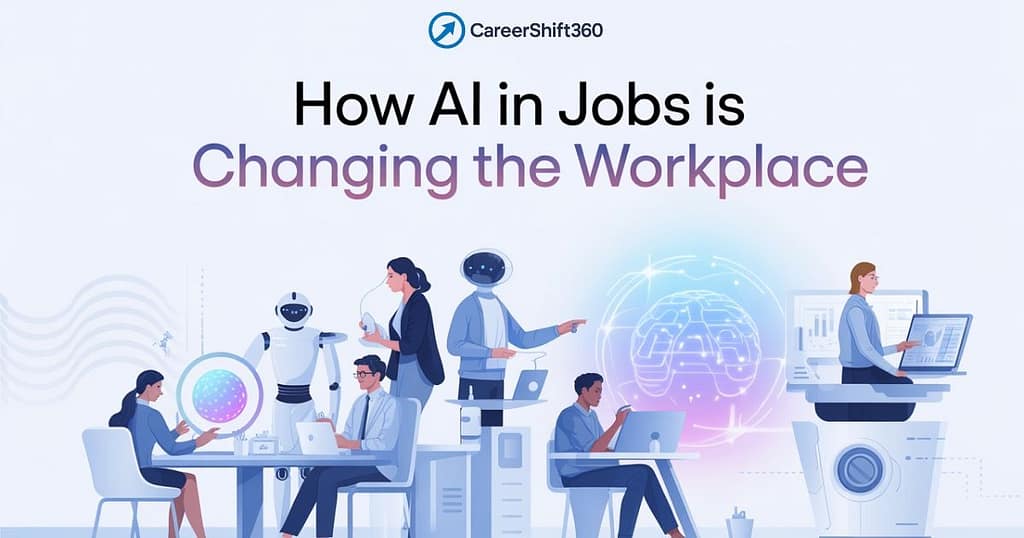
AI in jobs is changing how work is done, not just who does it.
Here are some major changes:
- Work is becoming faster
- Repeated tasks are handled by machines
- Humans are focusing more on thinking and creativity
- Remote and online jobs are increasing
Instead of replacing humans completely, AI is working with humans in many industries.
AI in Jobs and Automation of Routine Work
One of the biggest impacts of AI in jobs is automation. Automation means machines doing repeated work again and again without getting tired.
Examples of automated jobs:
- Data entry
- Billing and invoicing
- Basic customer support
- Factory assembly work
These tasks are usually boring and time-consuming. AI can do them faster and with fewer errors.
Problem:
People who only have routine skills may lose their jobs.
Solution:
Learning new skills that machines cannot easily copy, such as communication, problem-solving, and creativity.
AI in Jobs Across Different Industries
AI is affecting almost every industry. Let’s understand this in simple terms.
AI in Jobs in Healthcare
- AI helps doctors find diseases early
- AI reads X-rays and medical reports
- AI manages patient records
Doctors are still needed. AI only supports them.
AI in Jobs in Education
- AI helps students learn at their own speed
- Online tutors use AI
- Teachers save time on checking work
Teachers are becoming guides instead of just lecturers.
AI in Jobs in Business and Offices
- AI manages emails and schedules
- AI analyzes sales and customer data
- AI helps in hiring employees
This makes offices smarter and faster.
AI in Jobs in Manufacturing
- Robots work in factories
- Machines detect problems early
- Production becomes faster and safer
Humans now supervise machines instead of doing hard labor.
Positive Impact of AI in Jobs
AI in jobs is not only about job loss. It has many benefits.
Creates New Job Opportunities
AI has created new careers such as:
- AI trainer
- Data analyst
- Machine learning engineer
- Prompt writer
- AI content editor
These jobs did not exist before.
Improves Work Quality
AI reduces human mistakes and improves accuracy. This is very important in areas like healthcare and finance.
Saves Time and Energy
Machines can work 24/7. This helps humans focus on important decisions.
Makes Work Safer
AI does dangerous tasks like mining, chemical handling, and heavy lifting, keeping humans safe.
Negative Impact of AI in Jobs
Even though AI has benefits, it also creates problems.
Job Loss Fear
Many workers fear that AI will replace them.
Skill Gap Problem
People without technical skills may struggle to find new jobs.
Income Inequality
High-skill workers earn more, while low-skill workers may lose income.
Over-Dependence on Machines
Too much AI use can reduce human thinking skills.
Problem: Job Displacement Due to AI in Jobs
The biggest problem of AI in jobs is job displacement. This means people losing jobs because machines do the same work.
For example:
- Cashiers replaced by self-checkout machines
- Call center agents replaced by chatbots
- Factory workers replaced by robots
This creates stress, fear, and unemployment.
Solution: Learning New Skills for AI in Jobs
The best solution is reskilling and upskilling.
What Is Reskilling?
Learning a new skill for a new job.
What Is Upskilling?
Improving skills for your current job.
Skills that are safe from AI:
- Creativity
- Emotional intelligence
- Communication
- Leadership
- Critical thinking
Online courses, short training programs, and practical learning can help people stay relevant.
Problem: Lack of Education About AI in Jobs
Many people do not understand how AI works. This creates fear and confusion.
People think:
- AI will replace everyone
- Humans will become useless
- Machines will control everything
This is not true.
Solution: Awareness and Education About AI in Jobs
Governments, schools, and companies should teach:
- What AI is
- How AI helps humans
- How to work with AI
When people understand AI, they fear it less and use it better.
AI in Jobs and the Future of Work
The future of work will be a mix of humans and machines working together.
Future trends include:
- More remote jobs
- More freelance and online work
- More focus on skills, not degrees
- Lifelong learning culture
AI will not replace humans, but humans who use AI will replace those who don’t.
AI in Jobs for Students and Freshers
Students should not fear AI. Instead, they should prepare for it.
Helpful steps:
- Learn digital skills
- Understand basic AI tools
- Improve communication skills
- Practice problem-solving
AI can become a strong career partner if used correctly.
Role of Governments in Managing AI in Jobs
Governments play an important role in reducing AI job problems.
They can:
- Create training programs
- Support unemployed workers
- Set rules for fair AI use
- Encourage new job creation
Good policies can turn AI into a blessing instead of a problem.
AI in Jobs and Ethical Concerns
Ethics means doing the right thing.
Concerns include:
- Data privacy
- Fair hiring decisions
- AI bias
- Job fairness
Companies must use AI responsibly and transparently.
Can AI Fully Replace Humans in Jobs?

The simple answer is NO.
AI cannot:
- Feel emotions
- Understand human values
- Replace creativity
- Replace human care and empathy
Jobs that involve humans helping humans will always exist.
How Individuals Can Prepare for AI in Jobs
You don’t need to become a programmer to survive AI.
Simple steps:
- Stay curious
- Learn continuously
- Adapt to change
- Use AI tools instead of fearing them
AI is a tool, not an enemy.
Also Read Make Money on Fiverr
Final Thoughts on AI in Jobs
The impact of AI in jobs is real and powerful. AI is changing how we work, learn, and grow. While it does remove some jobs, it also creates many new opportunities. The real problem is not AI the problem is lack of preparation.
With the right skills, education, and mindset, humans can work with AI, not against it. The future belongs to those who are ready to learn, adapt, and grow.
AI in jobs is not the end of human work. It is the beginning of smarter work.
FAQs
Is AI dangerous for human jobs?
AI is not dangerous itself, but it can replace some routine jobs if people do not learn new skills.
How does AI affect human jobs?
AI automates repeated tasks, changes how work is done, and creates new job opportunities at the same time.
Which jobs are in danger with AI?
Jobs with repetitive work like data entry, basic customer support, and factory tasks are more at risk.
Is it bad to use AI for work?
No, using AI is helpful when it saves time and improves quality, as long as humans stay in control.
Can AI be 100% trusted?
No, AI can make mistakes, so human checking and decision-making are always important.